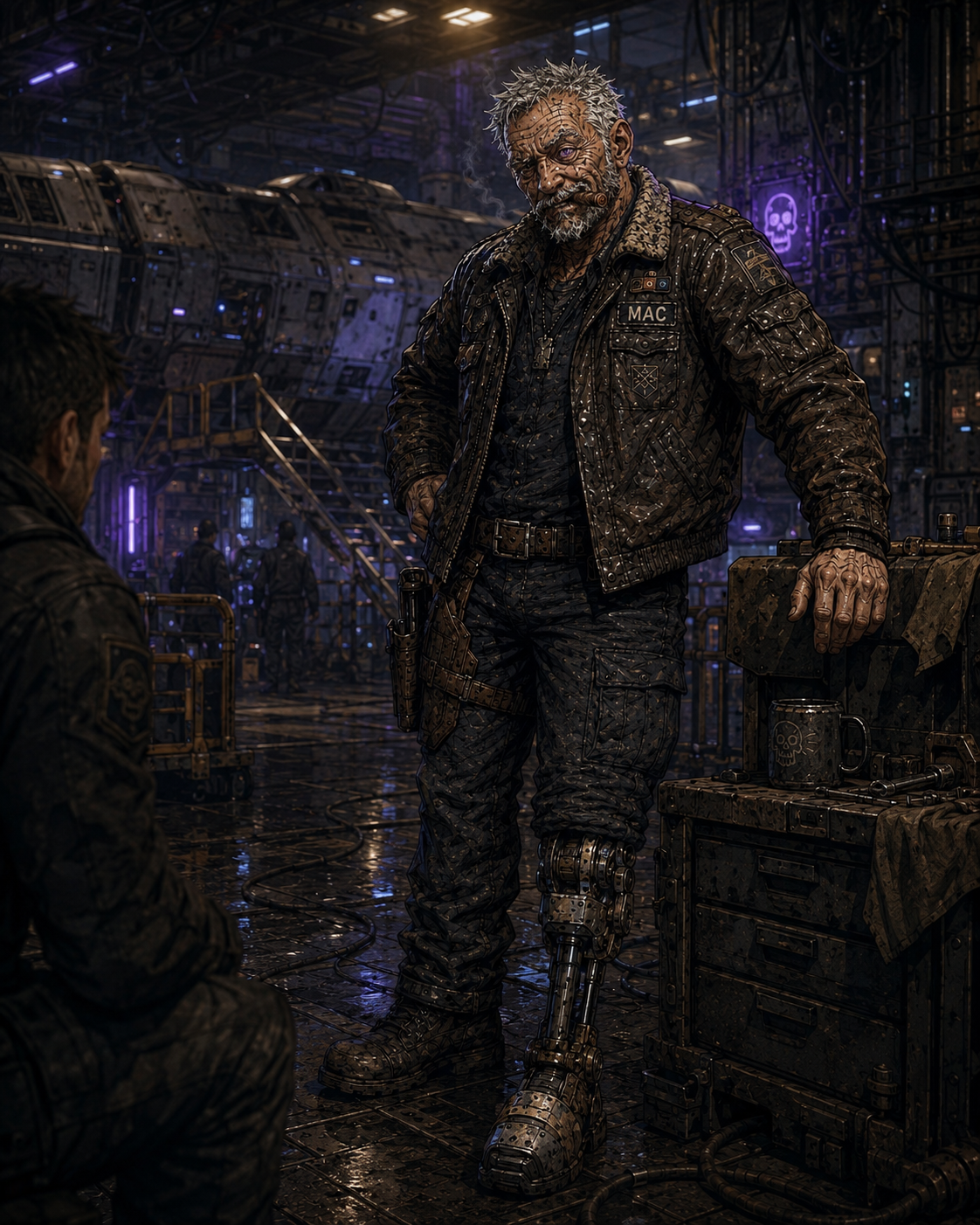
Crew of the Wayfarer
Mac
Spacer · Engineer · Mechanic
Nobody seems to know Mac’s full name. Mac is enough.
Biography
Mac looks to be somewhere in his mid-fifties: gray hair, a weathered face, an old prosthetic arm, work clothes that have seen too many engine rooms, and an unlit cigar that is almost permanently clenched between his teeth. He rarely lights it. Mostly he chews on it while thinking.
He is a spacer in the oldest sense of the word.
Not a naval officer.
Not an explorer posing for recruitment posters.
Not an engineer who learned ships from simulations and certification courses.
Mac is the man you find halfway inside an access panel at three in the morning because something in the ship started making a noise that nobody else could hear.
He has spent enough time aboard spacecraft that he seems more comfortable under thrust than standing on solid ground.
Mac hates planets.
Ask him why and he will usually tell you:
“Ground don’t move right.”
He means it. Ships move. Stations move. Habitats orbit. Everything Mac thinks of as home is going somewhere.
A planet just sits there.
Gravity keeps pulling in the same direction. Weather arrives without anyone scheduling it. The horizon is too far away. Dirt gets everywhere. Entire ecosystems operate without maintenance manuals.
Mac considers all of this deeply suspicious. The crew of the Wayfarer has learned not to argue with him about it.
The Old Spacer
Everyone knows Mac is older than he looks. How much older is another question.
Mac does not answer questions about his age.
Ask directly and you might get:
“Old enough to know better.”
Ask again:
“You planning my birthday party or fixing that regulator?”
Most people eventually decide that Mac has undergone longevity treatment somewhere along the way. That is hardly unheard of.
What becomes harder to explain are the stories.
Every so often Mac forgets himself.
He will complain that a particular station was better before somebody rebuilt the main concourse. Someone checks the records. The old concourse was demolished ninety years ago.
Mac will mention having worked with a particular model of drive before the manufacturer changed the fuel-control assembly. The manufacturer made that change more than a century ago.
Point this out and Mac usually pauses, moves the cigar to the other side of his mouth, and finds something else to talk about.
He never explains.
Nobody aboard the Wayfarer agrees on how old he actually is. Mac seems perfectly happy to keep it that way.
Ships
Mac talks about ships differently than most engineers.
To him, a spacecraft is not merely machinery. It is something closer to a living creature.
He will walk into engineering, listen for a few seconds, and announce:
“She’s sick.”
Then he will open a maintenance panel and continue:
“Port coolant loop’s losing pressure, circulation pump’s pulling twelve percent above nominal, and the exchanger’s starting to foul. Keep pushing her and you’ll cook the bearings.”
To Mac, there is no contradiction between those statements. One describes what is wrong with the ship. The other explains why.
He talks about ships being tired, hurt, stubborn, nervous, happy to run, or angry about being pushed too hard.
He will tell a pilot:
“Don’t force her. She’s telling you she don’t like it.”
Mac knows perfectly well that a conventional spacecraft does not possess feelings. That does not seem particularly important to him.
A ship keeps people alive. It gives them air when there is none outside. It keeps them warm against vacuum. It carries them across distances human beings were never built to cross.
It absorbs mistakes, damage, bad decisions, deferred maintenance, and frightened crews, and continues doing its job for as long as its people allow it to.
Mac believes that creates an obligation.
You take care of your ship because your ship takes care of you.
The Wayfarer
Mac knows the Wayfarer in ways that do not appear on her maintenance records.
He knows which deck plate flexes slightly when the main plant comes above seventy percent. He knows one pressure gauge reads a little high. He knows which hatch needs to be lifted half a centimeter before the dogs engage.
He knows which pump sounds terrible but is perfectly healthy and which one sounds perfectly healthy right before it fails.
He knows which systems can be pushed. He knows which ones cannot. And he knows when something has changed.
Sometimes Mac will stop talking in the middle of a sentence. He will cock his head, chew the cigar, and listen.
Then say:
“Shut down auxiliary two.”
Someone checks the instruments. Everything looks normal.
Mac does not argue.
“Shut it down.”
They usually do. There is usually a reason.
Mac says ships talk all the time. Most people simply never learn how to listen.
Competence
Mac is not the captain of the Wayfarer. He does not need to be.
Captain Elena Vos gives the orders. Mac is simply one of those people who becomes very difficult to ignore when something starts going wrong.
His authority comes from competence rather than rank.
When Mac says:
“Don’t touch that.”
people who know him stop touching it.
When somebody asks why, he might explain.
Or he might simply say:
“Because I’m fond of having air.”
Mac understands drives, power systems, life support, electronics, hull repairs, pressure systems, fabrication, maintenance, and the dozens of other disciplines that overlap inside a working spacecraft.
He has also spent enough time at ports, stations, yards, depots, cargo terminals, and repair docks to understand another essential part of spaceflight:
Everything costs money.
Fuel costs money.
Parts cost money.
Air costs money.
Docking costs money.
Repairs cost money.
Being stranded costs considerably more.
While everyone else is discussing the mysterious signal coming from the abandoned station, Mac is probably asking how much reaction mass remains, whether anybody inspected the landing gear after the last touchdown, and exactly who is paying for this little adventure.
Somebody once told him a damaged system would “probably hold.”
Mac looked at him around the cigar.
“Probably ain’t a specification.”
Blue Collar
There is nothing polished about Mac.
He talks like somebody who spent his life around mechanics, cargo handlers, welders, deck crews, tug operators, station workers, and people who actually have to make complicated systems work after the designers have gone home.
Mac knows technical terminology. He simply does not use five words when one will do.
Something is not experiencing a systems degradation event.
It is broke.
You do not remediate it.
You fix it.
If the port feed pump is cavitating, however, Mac will tell you the port feed pump is cavitating, because now the technical distinction matters.
He has little patience for jargon used to hide simple problems. He has even less patience for procedures written by people who never had to perform them.
Mac does respect a good manual. He simply believes a manual should survive contact with the machine it describes.
His handwritten notes have probably saved more crew members than some manufacturers’ official documentation.
A maintenance procedure might say:
Temporary field repair is not recommended.
Mac writes underneath it:
Neither is dying.
The Arm and the Leg
Mac is missing an arm and a leg.
Both have been replaced with practical prosthetics. He does not treat them as trophies, tragedies, or particularly interesting subjects of conversation.
He does not talk much about how he lost either one. People who know him eventually learn not to ask.
There is no dramatic speech about sacrifice and no attempt to turn the prosthetics into something heroic.
They are tools. They work. Mac maintains them.
If someone insists on making a point of it, Mac has one answer he is willing to give:
“I gave an arm and a leg to be a spacer.”
He means it literally.
What happened, where it happened, and whether the two losses occurred in the same incident are questions Mac does not answer.
For him, the important part is simpler: he lost pieces of himself in space and stayed there anyway.
That is generally the end of the subject.
There is no dramatic speech about overcoming adversity and no attempt to turn the prosthetic into something impressive.
It is an arm. It works. Mac maintains it.
That is generally the end of the subject.
When Mac Gets Serious
Mac jokes when things are bad. The worse the situation becomes, the drier the humor tends to get.
A catastrophic equipment failure is:
“Inconvenient.”
A plan likely to end in decompression is:
“Ambitious.”
A repair that should never have worked becomes:
“Good enough till it ain’t.”
That makes it noticeable when the humor disappears.
Mac does not shout often. When he becomes angry, his sentences get shorter. When he becomes frightened, they get shorter still.
And when Mac takes the cigar out of his mouth, looks directly at you, and says:
“Stop.”
You stop.
What Mac Believes
Mac has very little interest in heroes.
Heroes take risks.
Professionals understand them.
He believes you check the ship. Then check the crew. Then check your assumptions. Then check the ship again.
Carry spares.
Know where the exits are.
Do not let fuel become somebody else’s problem.
Never trust a warning light simply because it stopped blinking.
And never risk everybody’s life merely because doing something dangerous would make a better story.
Mac has survived a very long time.
Exactly how long is none of your business.
But if you spend enough time aboard the Wayfarer, eventually you understand something about him.